
Rune of Havoc in Last Epoch shuffles the tiers of four non-sealed affixes on an exalted item. It preserves the affix identities while redistributing their tiers, making it useful when the item has a strong exalted tier on the wrong stat. It does not guarantee that your desired affix receives the highest tier, and a valid shuffle can leave the particular affix you care about unchanged.
Use it after preparing the item, with enough forging potential for the remaining work. For Season 5 farming, build a sustainable source of generic rune drops, then add compatible Weaver Tree bonuses or Circle of Fortune Prophecies. Avoid treating a rare rune as a promise that an unfinished base will become a perfect item.
Check whether the item is eligible
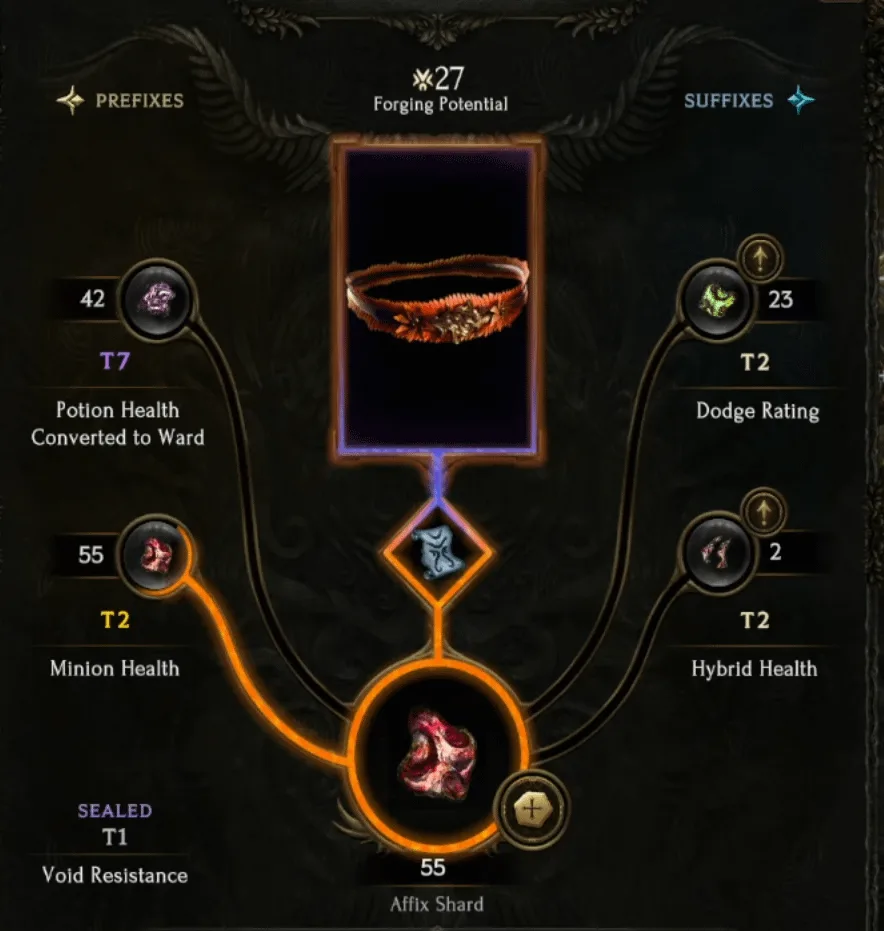
The item must be exalted and have four non-sealed affixes. A sealed affix sits outside the four-affix shuffle, so count the active affixes separately rather than relying on the total number of lines displayed in the tooltip. If an active slot is empty, complete the intended setup before attempting Havoc.
Also inspect the item base. Moving a high tier onto a useful stat does not fix an unsuitable implicit or make an item fit a different equipment slot. Decide whether you want to equip the finished piece or use it as a later legendary donor. Those destinations influence which affixes are worth preserving.
Keep enough forging potential for the operations that still matter. Preparing the affixes, applying Havoc and finishing useful rolls all compete for the item's remaining capacity. An attractive starting tier with very little capacity may be a worse candidate than a less dramatic item that is easier to prepare.
Before spending the rune, identify the target affix by name. A plan such as “make this better” gives you no clear stopping point. A plan such as “move the exalted tier onto hybrid health” lets you evaluate the result immediately and decide whether another attempt is worthwhile.
Separate the affix from its tier
Consider an item with mana, mana regeneration, health and a resistance. Havoc rearranges their tiers. It does not replace the resistance with a different resistance, add an unrelated class affix, or copy the high-tier stat onto every line.
This distinction is the reason the target affix must already be present before shuffling. If you want a higher-tier version of a rare craftable affix, add that affix in an appropriate open slot while the item can still be prepared. Havoc then offers a route to place an existing exalted tier on it.
A result can be technically different without being useful for your purpose. Two other affixes may exchange tiers while the high tier remains where it was. That is not the same as the rune performing no shuffle, and it is not proof that the desired stat is forbidden from receiving the high tier.
Read all four active affix tiers after each attempt. Looking only at the target line hides what actually changed and encourages mistaken conclusions about the rune. Record the full arrangement mentally before deciding whether to continue. The next attempt begins from the current arrangement, not from the original item you picked up.
Prepare the lower tiers deliberately
When one affix has a high tier and the other three share the same lower tier, any changed tier arrangement must move the distinct high tier somewhere else. This makes the outcome easier to reason about than a starting item with several different lower tiers. It still does not force the high tier onto your chosen target.
| Starting arrangement | Practical implication |
|---|---|
| One high tier and three matching lower tiers | The distinct tier must move for the overall tier arrangement to change |
| One high tier and several different lower tiers | A shuffle of lower tiers can change the item while leaving the high tier in place |
| Multiple exalted tiers | More than one valuable tier may move; assess the complete result |
| A sealed affix alongside four active affixes | The sealed line is outside the active shuffle |
Do not upgrade every lower affix to tier five by habit. Matching lower tiers can be achieved at a lower level when the starting item permits it, preserving more capacity for attempts and finishing. The useful preparation depends on the item you actually have.
If an unwanted active affix blocks the target, decide how to remove or seal it before committing to the shuffle. Removal can hit a valuable line, and a failed sealing plan can leave the affix at another tier. Those operations add risk and cost before Havoc has even been used.
Apply the rune with a stopping rule
Use this sequence for a straightforward single-target craft:
- Pick an exalted base that serves the eventual equipment or donor purpose.
- Identify the affix that should receive the exalted tier.
- Ensure that target is among the four non-sealed affixes.
- Compare the lower tiers and prepare them only when the cost is acceptable.
- Keep enough capacity for the finishing operations you still need.
- Apply Havoc and inspect every active tier.
- Stop when the item achieves the useful target or no longer supports the remaining plan.
The last step prevents a successful partial craft from being ruined by an unnecessary extra attempt. If the desired high-tier stat is now in place, another shuffle can move it away again. Decide whether the remaining affixes are acceptable before touching the rune slot.
Likewise, stop when the base loses the capacity needed for its destination. A legendary donor may still be useful without every affix perfected, while an equipped item may need an immediate resistance or health upgrade. The stopping rule should follow that practical use rather than an imagined perfect version.
Do not evaluate the craft by the number of previous attempts. Runes already spent do not make the next result more obligated to help you. Reassess the current base and remaining capacity after each roll, especially when an expensive preparation sequence preceded the first attempt.
Finish the successful item for its intended use
Once the exalted tier lands on the desired stat, finish the other affixes that support the character or the eventual donor. Avoid another Havoc application unless you have deliberately changed the goal and accepted that the useful high tier can move again.
A donor for a unique with Legendary Potential needs an eligible exalted item of the appropriate type. The chosen donor affixes matter because legendary crafting transfers from that item. At Temporal Sanctum tier two and above, the current crafting system allows a specified affix transfer, but the remaining transferred affixes still depend on the unique's Legendary Potential and the eligible donor setup.
That connection makes Havoc useful for preparing a strong desired donor affix, not a universal guarantee that every legendary outcome will be ideal. Improving the target tier does not make the donor's other lines useful automatically. If the unique has more potential, evaluate the additional affixes before consuming the donor.
For an item you will equip directly, review the character after the swap. The new high-tier stat may replace a defensive affix that the old piece supplied. Keep the previous item available until the whole setup is checked, particularly when the craft changes resistance coverage or recovery.
Farm rune volume at a sustainable difficulty
Generic rune drops can produce Rune of Havoc, so a practical starting farm focuses on content the build can clear consistently while generating many runes. Rare-enemy and Champion density are useful directions. A harder area is not automatically a better farm if deaths, long fights or resource stalls sharply reduce completed encounters.
The Weaver Tree can support this plan through Fury and Fortune, which enrages rare enemies while improving rune and glyph rewards. Champion-focused choices increase relevant enemy encounters, while Runic Horde adds rune piles from Echo completion. Loot Lizards provide another source of burst loot that can include runes.
Allocate around the activities you actually run. A bonus aimed at encounters you rarely reach is less useful than a smaller effect that activates throughout the farming session. Also consider the danger from enraged rares before using the setup on a character whose defenses are unfinished.
Compare the farm by the full loop: travel, kills, objective completion, reward collection and resets. A dramatic pile from one encounter does not establish a reliable hourly result. Use a repeatable route that also advances another goal, such as Favor or equipment progression, when the desired rune does not appear.
Add Prophecies or demanding farms selectively
Circle of Fortune can target generic rune rewards through Prophecies. In Season 5, use the current charge-based system rather than following an older routine built around repeatedly rerolling Prophecies. Match the reward type to an activity condition you can complete efficiently.
Rune Prison Complex is a suggested mapping option because monster volume and Champions can supply rune opportunities while generating Favor for additional Prophecy use. Soul Foundry is another high-volume option involving Praetor Taranis and Praetor Vul'arta. It can be dangerous, so avoid moving there solely because another build handles it easily.
Uber Aberroth is a demanding bossing destination for Havoc farming. Choose it when the character can complete the encounter consistently and the access cost makes sense. It is not a substitute for a basic mapping farm on a character still collecting its first functional items.
Lightless Arbor's Vault of Uncertain Fate offers reward modifiers that can increase rune and glyph output, but the gold cost and available choices vary. Treat it as a spending decision with uncertain returns. Do not divert the gold needed for ordinary crafting and progression into an expensive vault merely because the ideal modifier sequence looks attractive.
The practical choice is the farm your character can repeat safely with an acceptable cost. Combining rune volume, useful Weaver choices and compatible Prophecy rewards is more flexible than betting all progress on one high-end encounter.
Avoid the common expensive mistakes
Do not use Havoc before the desired affix is on the item. The rune redistributes tiers among existing active affixes; it cannot create the missing target from an unrelated line. Do not confuse a sealed fifth affix with one of the four participating lines either.
Do not assume every affix changes on every use. A full arrangement can change while your target remains unchanged. That is why mixed lower tiers can feel disappointing even though the rune behaved consistently with its shuffle description.
Do not spend the entire forging capacity making lower affixes look finished before attempting the main craft. If the target is the exalted tier, preparation should preserve a workable path to that result and the item's actual destination. A beautiful set of low-tier support affixes is not useful if no capacity remains for the needed shuffle.
Finally, do not carry an older farming routine into Season 5 without checking its systems. Current CoF uses charges and lenses, and current legendary crafting distinguishes the tier-two-or-higher chosen transfer from the rest of the outcome. Keep the craft focused: eligible base, present target, manageable preparation, full-tier inspection and a clear stopping point.