A practical Last Epoch Dreamslash build starts with a Rogue who chooses Bladedancer, spends 10 points in its passive tree, and equips a melee weapon. For a straightforward first configuration, use Dreamslash to deliver Shadow Daggers through Collapsing Shadows, reduce its base mana cost with Distortion Blade, and support it with shadow generation and movement tools.
The important limitation is that a zero-cost Dreamslash does not make every triggered effect free. Recurring Dreams and Somnambulism can spend additional mana. Dreamshift also changes the shadow interaction completely, so keep it out of a setup whose purpose is having shadows copy the attack. This guide covers that shadow-copy route in Season 5 rather than treating every Dreamslash variant as one interchangeable build.
Establish the attack and shadow loop
Dreamslash combines a forward dash with a quick slash. If you are already within range, it performs the close attack; if you are farther away, it closes the gap and hits enemies along the path. An enemy can only take one of those two hits from the same use. Do not count the dash and slash as two guaranteed hits on one boss when evaluating damage.
Your shadows perform their own Dreamslash attacks and dash beyond their targets. Shadows must be within 12 meters of the target to be consumed by the skill. Their positions therefore matter: generating shadows somewhere behind you and immediately attacking a distant pack can produce a different result from generating them around the target.
The unconverted skill carries Physical, Melee, Area, Movement, and Dexterity tags. Added damage applies at 150% effectiveness, and each point of Dexterity grants 4% increased Dreamslash damage. These are starting properties. A conversion node can change which damage increases support its converted base damage, so evaluate the final tree rather than choosing gear solely from the original icon.
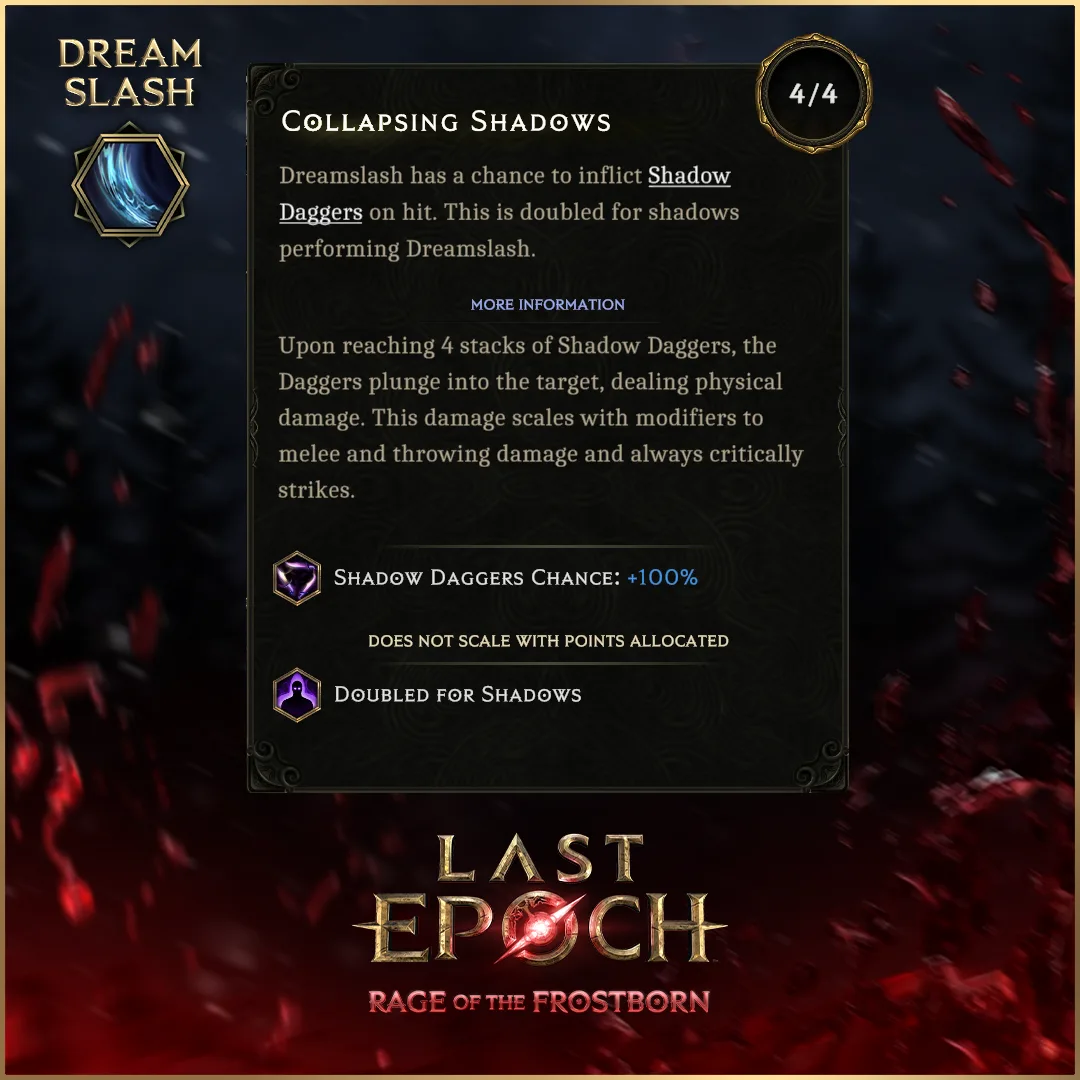
Collapsing Shadows grants 25% chance per point to inflict Shadow Daggers on hit, doubled for shadows performing Dreamslash. This is the reason to build around repeated attacks and available shadows. More attack speed is useful only while you can keep attacking, replenish shadows, and survive the position that each attack puts you in.
Use a coherent five-skill setup
A workable starting skill bar uses Dreamslash, Shift, Umbral Blades, Smoke Bomb, and Shadow Cascade. Each slot has a separate job. Dreamslash is the attack you repeat; Shift gives you a deliberate repositioning tool; Umbral Blades supports the Shadow Daggers approach; Smoke Bomb provides a place to establish shadow-related support; Shadow Cascade offers another attack within the same broader archetype.
| Skill | Job in this configuration | What to check before relying on it |
|---|---|---|
| Dreamslash | Repeated melee attack and Shadow Daggers delivery | Melee weapon, unlock, and shadow-copy nodes |
| Shift | Reposition between dangerous areas | Where the movement ends and which effects your tree actually triggers |
| Umbral Blades | Additional Shadow Daggers support | Its own specialization and whether you use it directly or through a trigger |
| Smoke Bomb | Shadow generation and a controlled fighting position | Current cooldown and the support nodes you have allocated |
| Shadow Cascade | Additional clear or deliberate mana support | Mana effects that specifically require a direct use |
This is a supported skill combination, not a claim that every skill tree can be filled with the same allocation. Read the effects you actually have. A skill placed on the bar is not automatically specialized into the version a guide describes, and a triggered version may have different conditions from a direct cast.
Synchronized Strike is a separate later option. In Season 5 it is Bladedancer-only and requires 35 points invested, rather than the older 10-point unlock. Do not make it a prerequisite for your first Dreamslash transition. If you later choose a configuration that uses it, account for that unlock and its mana demands before changing the bar.
Prioritize these Dreamslash nodes
Distortion Blade has three maximum points. Each point adds 5% increased attack speed and reduces mana cost by one. With all three points, the base cost of three becomes zero. That is a clear starting priority when you want repeated attacks without the basic cast draining your mana.
Collapsing Shadows supplies the Shadow Daggers infliction chance. Choose the path toward it when your intended damage route is Shadow Daggers, then use the remaining points to support the way you actually generate and consume shadows. Do not invent a complete point map from node descriptions alone; connections and available specialization points still control what you can allocate.
Umbral Recollection gives shadows performing Dreamslash a 10% chance per point to be resummoned after the attack, up to three points. A resummon consumes the original shadow and creates another at its position. It helps sustain the loop, but a chance to resummon is not a guarantee that every shadow remains available after every use.
Illusory Edge supplies more Dreamslash damage, while Imaginary Plate adds armor shred chance on its hits. Consider these as supporting choices after the attack's main purpose and resource behavior are established. Deadly Premonitions affects Dreamslash critical strike chance; it should not be selected merely because another part of the build benefits from critical multiplier.
Gathering Darkness introduces a minimum mana cost of one. Allocating it changes the zero-cost plan even when Distortion Blade is fully invested. Treat this as a conscious alternative, with a mana budget, rather than assuming its damage bonus has no resource consequence.
Keep alternative branches separate
Recurring Dreams can guarantee resummoning for up to one shadow per point, at five mana per affected shadow. It ignores shadows already successfully resummoned by another source such as Umbral Recollection. The cost therefore depends on what happened during that use, rather than being a fixed addition printed beside the basic three-mana cost.
For a low-maintenance opening configuration, leave Recurring Dreams out until you have checked sustained mana behavior. If you want the guaranteed resummons, add it deliberately and compare repeated boss attacks with pack clearing. Attack speed that feels comfortable in brief fights can drain your reserve during a long encounter.
Somnambulism makes shadows use a random specialized throwing skill and consumes that skill's mana cost. Those throws do not create or consume extra shadows, and Dreamslash effects relating to shadows performing Dreamslash do not automatically apply to them. Adding it introduces another damage and mana relationship that deserves its own configuration.
Narcolepsy generates Dream stacks and lets a direct Dreamslash consume a stack for 120% more damage, while selecting a random nearby target. Dreamwalker improves Dream gain with Dexterity. This can support a separate Dream-stack route, but random targeting changes your control over where attacks go.
Dreamshift prevents shadows from performing Dreamslash. Instead, it uses a shadow near an enemy to create a Dream stack and start the attack from the shadow's location when its conditions are met. It is a different movement pattern. Do not combine it with the expectation that Collapsing Shadows is receiving copied attacks from those same shadows.
Nightmare Steel removes Dreamslash's movement and instead releases a damage wave in the targeted direction, while remaining a melee attack. In patch 1.5.2, shadows copying this version aim toward your cursor rather than the endpoint of your attack. Keep that directional setup separate from the dash-based configuration described here.
Move into Dreamslash without breaking leveling
Before the unlock, keep a functional Rogue attack rather than waiting for a skill you cannot use. Shadow Rend or Puncture can serve as early tools, and Bladestorm is an available bridge within the leveling approach. Use the equipment and specialized skills you already have until your Bladedancer investment reaches the Dreamslash requirement.
The transition should be a small controlled change. Equip a melee weapon, put Dreamslash on the bar, and establish its basic cost and Collapsing Shadows direction. Keep your movement and supporting attacks available. Replacing every skill at once makes it harder to tell whether a problem comes from missing specialization points, lost defenses, or an unfinished shadow setup.
At first, judge the transition by ordinary fights. Can you consistently hit your intended target, keep mana available, and recover after taking damage? If these fail, return to the supporting skills or previous attack while you fix the specific issue. A newly unlocked skill does not require you to abandon a functioning leveling setup immediately.
During normal Monolith progression, prioritize reliable equipment over chase items. The route does not begin with a compulsory unique purchase. That gives you room to learn positioning and shadow timing before investing in a more elaborate version, but it does not guarantee a particular corruption level or boss clear.
Gear for the actual damage route and survival
Begin with a usable melee weapon and affixes that support your selected attack. Dexterity directly supports Dreamslash, while physical damage and appropriate added damage are relevant to the unconverted attack. If Shadow Daggers is your main payoff, evaluate improvements to that payoff rather than treating every increase to Dreamslash's displayed hit as an equal upgrade.
Attack speed deserves a resource check before every major increase. It makes the low-cost base attack smoother, but also increases how often resource-consuming shadow effects can occur. A faster weapon is not an automatic improvement if it turns your sustained rotation into alternating bursts and empty mana.
Keep resistances, health, and recovery on your equipment priorities. A movement-heavy attack does not prevent every hit or ground effect. If your build uses melee leech, check whether you can keep attacking safely enough to receive it during bosses; recovery that depends on damage can disappear precisely when you must stop attacking.
Siphon of Anguish, Smoke Weaver, and Carcinization of Momentum are later items to assess against a specific configuration. Do not assume all three belong in every version or that a named unique is better than a rare item that fixes an immediate defensive gap. Compare the whole replacement, including the stats you lose.
Treat Evade and Shift as separate actions when evaluating equipment. An effect that changes Evade does not establish that Shift's own cooldown disappears. Build your movement plan around the skill and item text, especially when considering rare items whose interactions are central to a specialized setup.
Execute a controlled combat rhythm
Against packs, establish the support you need, aim Dreamslash through the intended enemies, and use Shift to correct your position when hazards make another dash unsafe. Use Smoke Bomb where you can fight effectively rather than dropping it behind the pack and expecting its support to follow you everywhere.
Against bosses, begin with room to move and enough mana for required utility. Attack in safe windows, observe whether shadows are near enough to participate, and reposition before repeated dashes carry you into an unfavorable spot. The skill's Movement tag describes its behavior; it is not a promise that every attack avoids damage.
Use Shadow Cascade's mana support only in the form required by its nodes. Onslaught requires a direct use, and Fight in the Shadow grants four mana per active shadow when directly used. A cascade automatically triggered by another skill should not be counted as the same source of regeneration.
If you run out of mana, inspect Gathering Darkness, Recurring Dreams, Somnambulism, and any supporting skill that spends resources. Disable one optional expense at a time and repeat a sustained fight. If attacks stop reaching enemies, inspect target range and shadow positions before assuming the damage stats are wrong. If you die while attacking quickly, stabilize defenses and the movement pattern before adding more speed.